Why Fit Matters More on a Transit Than Almost Any Other Vehicle

Here's the thing about a Ford Transit: there's no single "Transit" shape. One version is a cargo van with a towering high roof. Another is a passenger wagon hauling people, not pallets. A third shows up as a cutaway or chassis cab, built for whatever upfit a business bolts onto the back. All three wear the same nameplate. All three need a completely different cover.
That's what makes a car cover size chart for Ford Transit a different animal than, say, a chart for a Camry or an Accord. With a sedan, trim level barely changes the exterior dimensions. With a Transit, trim level can mean a foot or more difference in roof height alone. A cover that fits one Transit in a work fleet might not come close to fitting the one parked next to it.
This article won't hand you a cutsheet of exact Transit measurements. That's not realistic given how many configurations exist. What it will do is walk you through how to read a size chart correctly, which dimensions actually matter, and how to verify fit before you spend money. For a van that often sits outside overnight at a job site or in a driveway, exposed to sun, rain, and whatever blows across the lot, getting this wrong isn't a small inconvenience. A loose or short cover flaps in the wind, lets water pool, and wears through faster than it should.
The Three Dimensions That Actually Change on a Ford Transit
Before you look at any chart, know your own van. Three variables decide whether a cover will fit, and all three can change within the same model year.
- Overall body length. Ford sells the Transit in regular, long, and extended lengths. The gap between the shortest and longest version is substantial, and a cover sized for one will either swallow or come up short on another.
- Roof height. Low, medium, and high roof options exist, and this is the dimension buyers skip past most often. People think about length because it's visually obvious. Roof height is easy to underestimate until the cover you bought sits two feet short of the roofline on a high-roof cargo van.
- Wheelbase. Regular and long wheelbase versions affect where the cover needs to tuck and tension underneath the body, separate from overall length.
Model year matters too. Ford has refreshed the Transit's styling, mirror design, and trim details across generations, and small changes like mirror shape or added trim pieces can affect how cleanly a cover sits around those points.
Before you shop, check the door jamb sticker, the VIN plate, or the owner's manual for the exact roof and length designation. Guessing from memory, or going off what a coworker's van looks like, is how people end up with the wrong size.
How Car Cover Size Charts Are Built (and Why They're a Starting Point, Not a Guarantee)
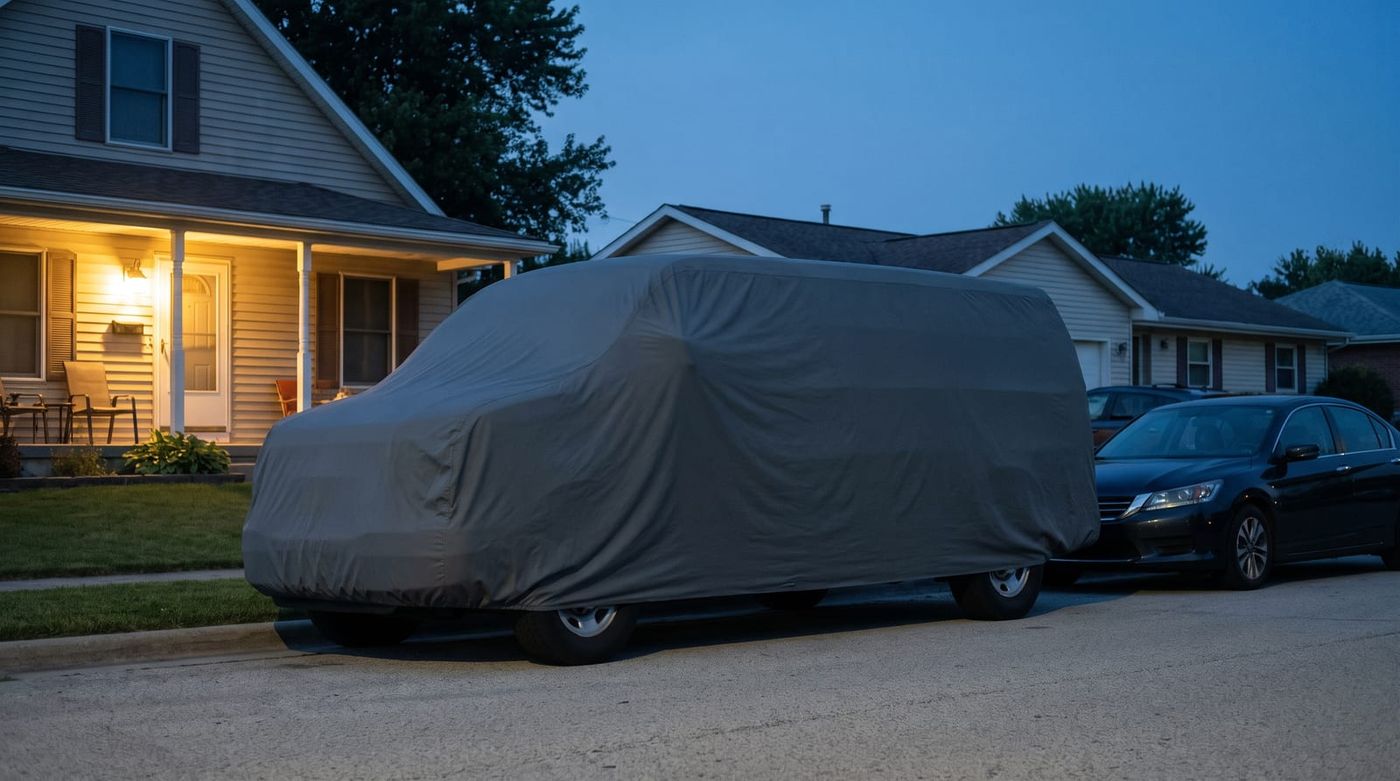
Most size charts group vehicles into length or class ranges rather than listing every single trim by name. That works fine for a vehicle category with limited variation. It works less well for vans, where "Transit" alone covers three roof heights and multiple lengths under one umbrella.
There's a real difference between a chart that lists your exact year and trim directly, and one that just buckets all Transit vans into a generic "full-size van" category. The first is useful. The second is a rough starting point at best, and treating it as a guarantee is how you end up with a cover that's close but not right.
Even when length and roof height line up, physical details can throw off the fit. Side ladders, roof racks, running boards, and rear cargo door hardware all change how a cover drapes and whether it clears everything cleanly. A cover that's technically "the right size" can still bunch up at a ladder mount or snag on a roof rack bracket.
The fastest way around all this guesswork is a tool built for exact vehicle lookup rather than a static chart you're interpreting on your own. If you want a deeper walkthrough on measuring and matching before you commit to a purchase, the what size car cover for my vehicle guide covers that process step by step.
Universal, Semi-Custom, and Custom-Fit Covers: What the Terms Actually Mean
These three terms get used loosely, but they mean specific things.
Universal covers are the cheapest option and the loosest fit. They're sized by rough length range, which means they're not shaped around a Transit's specific roofline or body contours at all. Semi-custom covers narrow things down by body style and length class, getting closer without being built around one exact configuration. Custom-fit covers are built to a specific year, make, model, and trim, and they track the vehicle's actual lines instead of approximating them.
The trade-off is straightforward. A looser cover flaps more in wind, and that constant movement creates wear points over time, usually at the edges first. A tighter-fitting cover holds its shape and stays put, but only if you picked the right one to begin with. For a vehicle with as much internal variation as the Transit, which fit category you choose matters more than it would for a single-body sedan where every trim is basically the same shape. You can see the difference in how these are described on the custom-fit car covers page.
Checklist: What to Confirm Before You Buy
Have this on hand before you buy anything:
- Model year
- Roof height designation (low, medium, or high roof)
- Wheelbase and body length designation (regular, long, or extended)
- Any roof racks, ladders, or aftermarket add-ons attached to the van
If your paperwork is unclear, or the van's been modified since it left the factory, grab a tape measure. Overall length and height, measured with the van parked on level ground, will tell you more than a trim badge that may not match the original spec anymore.
Check the return or exchange policy before you order, too. Even with good information, fit issues happen, and knowing you can send it back without a fight matters more on a vehicle this variable than it would on a standard sedan. For the full measuring process, the sizing guide is worth bookmarking before you start.
Where to Look Up Fit for Your Exact Transit
Once you've got your year, roof height, and length designation sorted, skip the generic chart and go straight to a lookup tool. The CoverFinder tool lets you enter year, make, model, and trim and returns options matched to that exact configuration, instead of making you guess which bucket your van falls into.
If you want to browse before narrowing down, the Ford van lineup page is a reasonable starting point to see what's currently available across Ford's van models before you drill into Transit specifics. From there, CoverFinder does the narrowing for you.
One warning worth repeating: don't rely on memory of a Transit you bought or covered years ago. Fleets often run multiple roof heights and lengths side by side, and "the van we always get" isn't a reliable spec sheet. Confirm the one in your driveway right now.
Protecting the Investment Once It Fits
Getting the right size is half the job. Installing it properly is the other half, especially on a high-roof Transit where you're dealing with a large, flat roof surface that catches wind like a sail if it's not secured. Straps and tie-downs matter more here than on a low-profile car. The installation guides and the simple installation walkthrough cover how to secure a cover properly and avoid the lift points that cause flapping and premature wear.
Beyond installation, basic care keeps a well-fitted cover looking and working like one. Regular cleaning, following a process like the one in the cover cleaning guide, extends material life through repeated seasons of outdoor storage. It's also worth checking warranty terms before you buy, particularly for a van that lives outside year-round rather than in a garage. The lifetime warranty page spells out what's actually covered.
Bottom Line: Match the Chart to Your Exact Transit, Not Just the Name
The Transit's length, roof height, and wheelbase variation means the nameplate alone tells you almost nothing about what size cover you need. Two Transits in the same fleet can need two completely different covers.
The path that actually works is simple: confirm your exact configuration first, roof height, length, wheelbase, model year, then match it using a proper sizing guide and a lookup tool built for exact vehicles, rather than eyeballing a general size chart and hoping for the best.
If you're still narrowing things down, it's worth browsing what's available for Ford vans and seeing how the options line up with your specific setup. And if you found this rundown useful, stick around the blog for more straight-talk guides on keeping your vehicle protected without the guesswork.